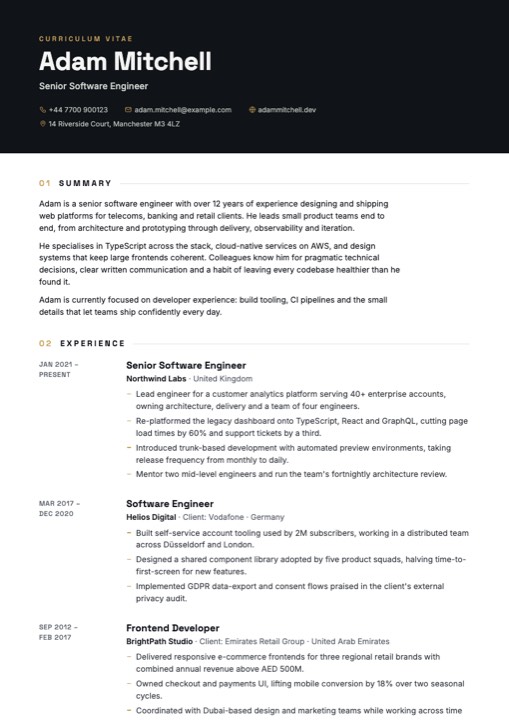
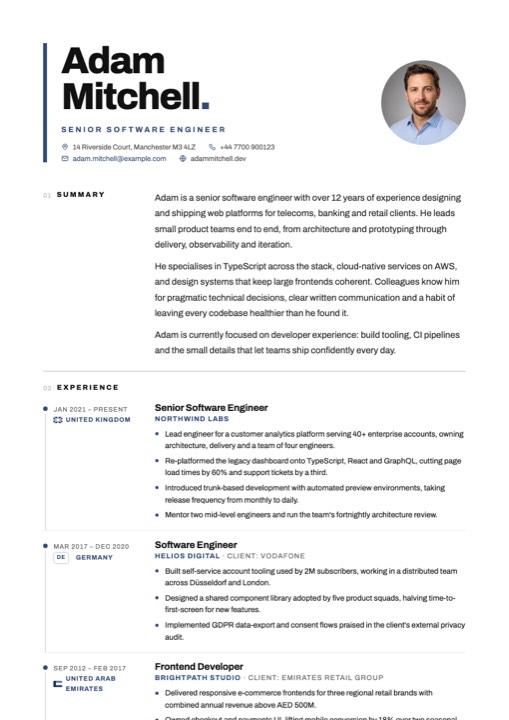
Tessira is a CV builder made by a one-person studio. There is no dashboard full of things you will never use — just an editor that saves itself, four templates that were actually designed, a PDF that prints properly, and an AI review that tells you what is wrong. This page explains each part and the reasoning behind it.
A CV is a small document you rewrite many times. The editor is built for the rewriting, not for the first draft.
Stop typing and your work is written a fraction of a second later. The indicator turns amber for “Saving…” and green for “All changes saved”. If a write fails it keeps retrying — it will never claim to have saved something it did not.
Each section is its own page with its own form, so you are never scrolling a single enormous document looking for the field you wanted. A rail down the side shows which sections have real content in them and which are still waiting.
Optional sections have a switch and a grip handle. The order in the rail is the order they render in the PDF, so rearranging your CV is a drag rather than a rewrite. A section you switch off simply is not there — no orphan heading, no gap.
Shaded sections are always on — a CV without them is not a CV. The rest are yours to switch off and reorder.
Experience and Education dates are month-and-year dropdowns with a “Present” option, rather than free text. You cannot end up with “Jan 2019” in one role and “01/2019” in the next, and Tessira can reason about the dates afterwards.
If there is more than a month between two consecutive roles, a quiet amber card appears above your entries naming the gap and its neighbours. It never blocks saving and it is never a popup — plenty of gaps are entirely reasonable, and it is your CV.
Apeal, Editorial, Swiss and Ink & Chartreuse are not skins on one layout — they have different structures, different typography and different ideas about what a reader does first. Your content is stored separately from all of them, so switching template reflows the same words into a new design and loses nothing.
Each template ships six accent colours chosen against that specific design, with an explicit darker partner for text and rules so contrast holds. If none of the six is right, a colour picker takes any hex you like and the darker partner is derived for you.
Most CV tools build an HTML preview and then hand your document to a separate conversion library, which is where fonts shift, page breaks move and background colours stop at the margin. Tessira does not do that.
Your CV is rendered in an actual browser engine and printed to A4 with backgrounds on. The page breaks in the file are the page breaks the layout engine decided on — the same ones you saw in the preview.
Browsers refuse to paint the printed page margin, whatever the CSS says. So after printing, Tessira writes the page colour underneath every page directly into the PDF. That is why a dark template stays dark right to the trim.
Every typeface a template uses is embedded in the file before printing, so the PDF looks the same on a recruiter's machine as it does on yours — including on one that has never heard of the font.
Two things separate this from pasting a CV into a chatbot: Tessira measures your document before the model sees it, and it checks the model's answer against your document afterwards.
Before anything is sent, Tessira counts: bullets, words, how many of them carry a real number, how many open with a strong verb, the estimated page count, the span of your career. It also locates concrete defects — clichés, filler, repeated openers, mixed UK and US spelling, over-long bullets, thin or bloated roles. Those go to the model as fact, so it spends its effort on judgement instead of counting.
The first pass is forensic: exact quotes from your CV with a suggested rewrite beside each one. The second is strategic: positioning, whether the top of page one survives a six-second scan, credibility, what a sceptical reader would probe, and an honest score. If the second pass fails, you still keep the first.
Every finding claims to quote a line from your CV. Any finding whose quote is not literally present is discarded before you see it, along with suggestions identical to the original and “no change needed” filler. Tessira tells you how many were dropped.
The review is performed by DeepSeek, an external AI provider. That is a real fact about the feature, so it is on this page rather than buried in a policy. Your CV is anonymised before it is sent, and you can read exactly what will be transmitted before you spend a run.
Job descriptions are workspace-level things in Tessira, not attachments to a single CV. Paste one in — or give Tessira a URL and let it try to pull out the title, company and body — and it joins a library you can match against for as long as the role is open.
A match gives you a score with its component parts, an explicit list of what the posting asks for that your CV already evidences, what it asks for that your CV does not, and ranked advice on closing the gap. Because the CV and the posting are separate records, you can match three CVs against one role, or one CV against six roles, without duplicating anything.
Every CV has its own overview: the state of the document before you start editing it, and the place both AI checks are run from.
A ring showing how far the document has got, with a legend counting sections that are done, started and empty. It reads the exact same measure the section rail does, so the two can never disagree with each other.
“Finish your CV” lists at most three things, ordered by how much they matter — half-done before empty, empty before stylistic. Reach a complete CV and the checklist is replaced by a finished state rather than an empty box.
Estimated pages, total words, number of roles, and when you last exported. All four are derived from what you have actually written — none of them is a target you are being nudged towards.
A review or match is stored on the CV, so it is still there tomorrow. Edit enough afterwards and the result is flagged as out of date rather than quietly presented as current.
A CV is one of the more personal documents you will ever write. Two things follow from that: it should be well kept, and you should be able to leave with it.
Your CVs and saved job descriptions are encrypted before they are stored, under a key belonging to your account alone, and every record lives in a namespace keyed to your account. This is encryption at rest, not end-to-end: Tessira holds the key, which is precisely what lets a forgotten password be recovered without destroying your work.
Any CV downloads as a plain, readable JSON file containing your content and nothing else — no internal identifiers, no tracking. Import it back into any CV to replace its contents completely, or keep it as a backup that no longer depends on Tessira existing.
Email and password, with the address verified before you can sign in. Passwords are stored one-way, so nobody can read yours back — including us. A password reset uses a short-lived code sent to your inbox and signs out every other device.
Make an account, paste in what you already have, and see how the document looks once it is properly typeset. Free to use, and yours to export whenever you want.